
AI for Google Ads uses machine learning to adjust bids, match search intent, and generate ad copy in real time, all without requiring manual intervention on every auction. The result is faster optimization, sharper targeting, and measurable gains in return on ad spend. At the core are tools like Smart Bidding and AI Max for Search, which together handle the kind of granular, split-second decisions no human team could replicate at scale.
Here is what AI actually does inside a Google Ads account:
- Bid optimization: Adjusts bids at every auction based on device, location, time of day, and user behavior
- Audience targeting: Identifies high-intent users beyond your existing keyword lists using keywordless matching
- Ad customization: Generates headlines and descriptions tailored to each search query using generative AI
- Performance forecasting: Predicts conversion likelihood before committing budget
- Automated reporting: Surfaces anomalies and opportunities without manual data pulls
For businesses investing significantly in Google Ads, these capabilities are essential. They are the difference between a campaign that bleeds budget and one that compounds returns.
Table of Contents
- 1. How Smart Bidding uses AI to win the right auctions
- 2. What AI Max for Search does that standard campaigns cannot
- 3. Four ways to automate Google Ads management with AI
- 4. Why human oversight is non-negotiable with AI-powered campaigns
- 5. How expert agency management gets more from AI than in-house teams typically can
- North Country Consulting delivers senior-led AI management for high-spend advertisers
- Key Takeaways
1. How Smart Bidding uses AI to win the right auctions
Smart Bidding is Google’s auction-time bidding system, and it is the most direct application of machine learning in Google Ads. Rather than setting a single max CPC for a keyword, Smart Bidding evaluates billions of signal combinations at every auction and sets a precise bid for that specific query, from that specific user, in that specific context.
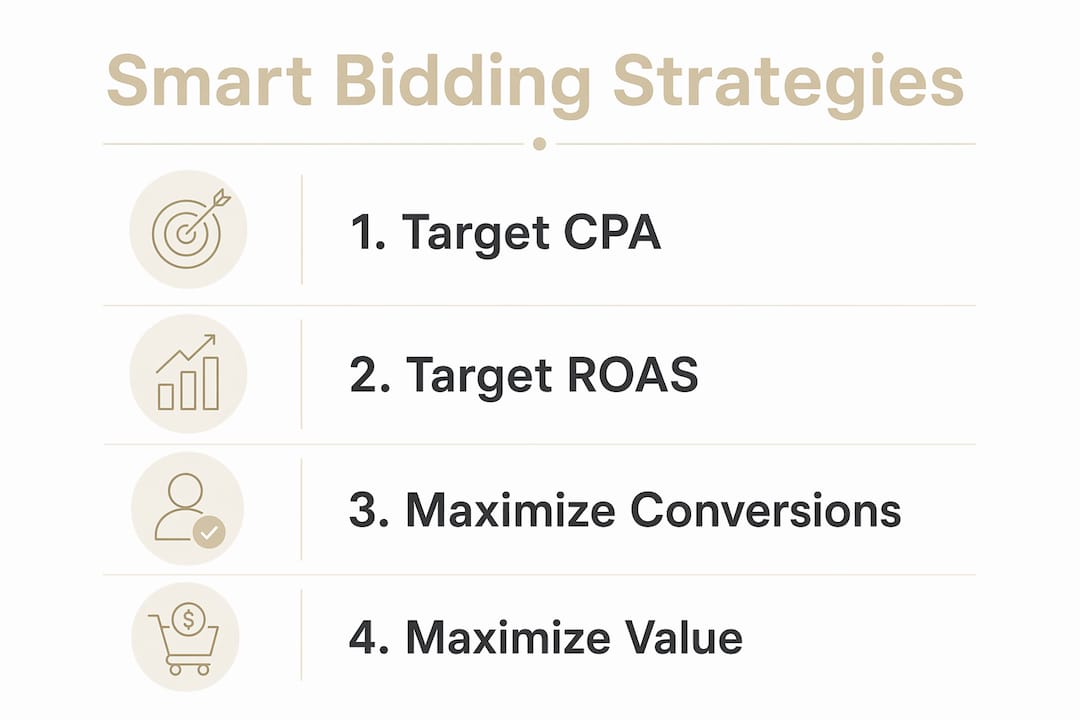
The four core strategies are Target CPA, Target ROAS, Maximize Conversions, and Maximize Conversion Value. Each one optimizes for a different business objective, but all four share the same underlying mechanism: real-time signal processing across device type, geographic location, time of day, remarketing list membership, language, and operating system.
A practical example: a Target ROAS campaign for an e-commerce brand will bid aggressively for a returning cart abandoner searching on a desktop at 8 PM, and pull back on a first-time mobile visitor at 6 AM, all automatically. That kind of nuance is impossible to replicate with manual bidding rules.
Pro Tip: Before activating any Smart Bidding strategy, confirm your conversion tracking is accurate and your conversion window matches your actual sales cycle. Smart Bidding is only as good as the data it learns from. Garbage in, garbage out.
- Target CPA: Maximizes conversions at a defined cost per acquisition
- Target ROAS: Maximizes conversion value relative to spend
- Maximize Conversions: Spends your full budget to get the most conversions possible
- Maximize Conversion Value: Prioritizes high-value conversions within budget
For a deeper look at how these strategies interact with campaign structure, the Smart Bidding strategies guide covers the practical tradeoffs in detail.
2. What AI Max for Search does that standard campaigns cannot
AI Max for Search is not a new campaign type. It is an optimization layer you enable on top of an existing Search campaign, and it changes two things fundamentally: how your ads match to queries, and how your ad copy gets written.
On the matching side, AI Max activates broad match and keywordless targeting simultaneously. The system learns from your existing keywords, landing pages, and ad creatives to identify relevant queries you never explicitly targeted. This is particularly valuable for broad match strategies where AI-driven expansion can surface high-intent traffic that manual keyword research misses.
On the creative side, AI Max uses generative AI to write customized headlines and descriptions matched to each user’s search. It pulls from your existing ad copy, landing page content, and the query itself. The output is ad text that feels specific rather than generic, which typically improves click-through rates. Final URL expansion also routes users to the most relevant page on your site rather than a single landing page.

The controls matter here. Brand safety settings let you specify which brands your ads associate with or exclude. URL inclusions and exclusions give you guardrails on where traffic lands. You keep strategic control while AI handles execution. For more on how AI is reshaping search visibility, this overview of AI-driven search strategies is worth reading.
3. Four ways to automate Google Ads management with AI
Not all Google Ads automation is the same. The method you choose determines how much flexibility you get, how much technical skill you need, and how much risk you carry.
- Native automated rules: Built into the Google Ads interface. Good for simple, recurring tasks like pausing low-performing keywords or adjusting budgets based on performance thresholds. No coding required, but limited in scope.
- Google Ads scripts: JavaScript-based automation that runs directly in your account. Scripts handle bulk changes across large accounts, multi-account reporting, and bid adjustments at scale. The catch: they are largely irreversible and require real coding knowledge. Best suited for technically skilled teams managing high-spend accounts.
- Third-party SaaS bid managers: Platforms that layer rule engines and portfolio bidding on top of Google’s native tools. Useful for cross-channel budget management and more sophisticated bidding logic than native rules allow.
- AI agents using Model Context Protocol (MCP): The most advanced option. These agents accept plain-English instructions, analyze campaign data, suggest strategy changes, and execute actions conversationally. They go well beyond scripts by combining analysis, strategy, and execution in a single workflow.
The trend is clear: AI agents are taking over tasks that scripts once handled, and they are doing it with far less technical overhead. That said, each tier still has a place depending on your team’s capabilities and the complexity of your account.
4. Why human oversight is non-negotiable with AI-powered campaigns
AI can optimize a bid in milliseconds. It cannot tell you whether a campaign aligns with a product launch you just delayed, a pricing change that went live this morning, or a brand crisis unfolding on social media. That gap is where human oversight earns its keep.
Google’s own guidance on tools like Ask Advisor is explicit: these tools augment human decision-making, they do not replace it. Ask Advisor can surface optimization suggestions, generate assets, and assist with troubleshooting, but every significant action still requires human approval.
The safety protocols that matter most in practice:
- Staged implementation: Roll out AI-driven changes incrementally, not all at once
- Paused campaign creation: Build new AI-generated campaigns in a paused state before they go live
- Explicit confirmation for deletions: Never allow AI agents to delete keywords, ad groups, or campaigns without a manual confirmation step
- Regular performance reviews: Set a weekly cadence to audit AI decisions against business objectives
Over-automation without these guardrails is one of the most common and costly mistakes in Google Ads management. An AI agent optimizing toward the wrong conversion event, or bidding aggressively into a margin-negative product category, can burn through significant budget before anyone notices. The fix is not less AI. It is better human oversight of what the AI is doing.
5. How expert agency management gets more from AI than in-house teams typically can
AI tools give every advertiser access to the same machine learning infrastructure. What separates accounts that achieve 8.7× return on ad spend from those that plateau is not the tools. It is the strategic layer on top of them.
North Country Consulting’s approach is built around senior-led oversight of every account, not junior account managers running templated playbooks. That means the AI’s outputs get reviewed by people who understand attribution modeling, margin-based cohort targeting, and full-funnel campaign architecture. Smart Bidding set against the wrong conversion event is worse than no Smart Bidding at all. Getting that foundation right is where expert management pays for itself.
A few areas where senior oversight consistently outperforms self-managed AI campaigns:
- Conversion tracking architecture: AI is only as accurate as the signals it receives. Misconfigured tracking is the single most common reason Smart Bidding underperforms.
- Non-branded campaign structure: AI tends to over-index on branded queries because they convert easily. Expert management builds separate non-branded campaigns to capture net-new demand.
- Margin-based bidding: Feeding actual margin data into Target ROAS campaigns, rather than revenue, produces materially different bid decisions.
A free strategy audit from North Country Consulting identifies exactly where these gaps exist in your current account, before they cost you another month of wasted spend.
Pro Tip: If your Smart Bidding campaigns have been live for less than 30 days or have fewer than 50 conversions in the past month, they are still in the learning phase. Changing bids, budgets, or targeting during this window resets the learning period and delays performance gains. North Country Consulting achieves an average 8.7× return on ad spend by pairing AI automation with senior-led account management.
North Country Consulting delivers senior-led AI management for high-spend advertisers
Most businesses spending $25,000 or more per month on Google Ads are leaving money on the table, not because they lack access to AI tools, but because those tools are running without the strategic oversight that makes them work. North Country Consulting is built specifically for this gap. With over $40 million in managed ad spend and an average 8.7× return on ad spend across client accounts, the firm combines AI automation with senior-level expertise that most in-house teams and traditional agencies cannot match.
Every engagement starts with a no-cost strategy audit that maps your current account structure, identifies conversion tracking gaps, and surfaces the specific AI-driven opportunities your campaigns are missing. No junior account managers, no templated recommendations. If you are ready to see what your Google Ads account should actually be returning, request your free audit today.
Key Takeaways
AI for Google Ads delivers the highest returns when machine learning automation runs under senior strategic oversight, with accurate conversion tracking and properly structured campaigns as the foundation.
| Point | Details |
|---|---|
| Smart Bidding precision | Target CPA, Target ROAS, Maximize Conversions, and Maximize Conversion Value each optimize bids using real-time auction signals. |
| AI Max for Search | Activates keywordless targeting and generative ad copy to reach high-intent queries beyond your existing keyword list. |
| Four automation tiers | Native rules, scripts, third-party SaaS, and AI agents via MCP offer increasing flexibility and complexity. |
| Human oversight is required | AI agents need safety rails: staged rollouts, paused campaign creation, and manual confirmation for destructive actions. |
| North Country Consulting | Achieves an average 8.7× return on ad spend by pairing AI automation with senior-led account management and free strategy audits. |